Kwality Wall's (India) Limited Demerger Raises a Larger Question: When Regulatory Pricing Meets Minority Shareholder Reality
Some market situations are not easy to classify as right or wrong. They are legally correct, structurally sound, and yet they leave investors with an uncomfortable question in mind.
The recent journey of Kwality Wall's (India) Limited is one such case.
At first glance, this looked like a straightforward corporate restructuring.
In January 2025, Hindustan Unilever Limited decided to separate its ice cream business — understandable, because ice cream is a very different business from soaps, detergents or packaged foods. It has its own economics:
- cold-chain dependency
- seasonality
- higher logistics intensity
- different capital deployment needs
So a standalone structure made sense. And naturally, shareholders welcomed it as value unlocking.
Parallel to India, Unilever globally began separating its ice cream division into an independent business under The Magnum Ice Cream Company. This was not merely an India event. It was part of Unilever’s worldwide restructuring.
Even before Indian price discovery matured in June 2025, Magnum signed an agreement to acquire 61.9% stake in Kwality Wall’s India from HUL. This date is critical because strategic control economics were effectively locked before public markets had sufficient time to independently discover value.
But value unlocking is rarely as simple as receiving one extra share
When the demerger happened in December 2025, shareholders received one Kwality Wall’s share for every HUL share held.
On paper, that looked like an additional benefit. But in markets, nothing is truly free.
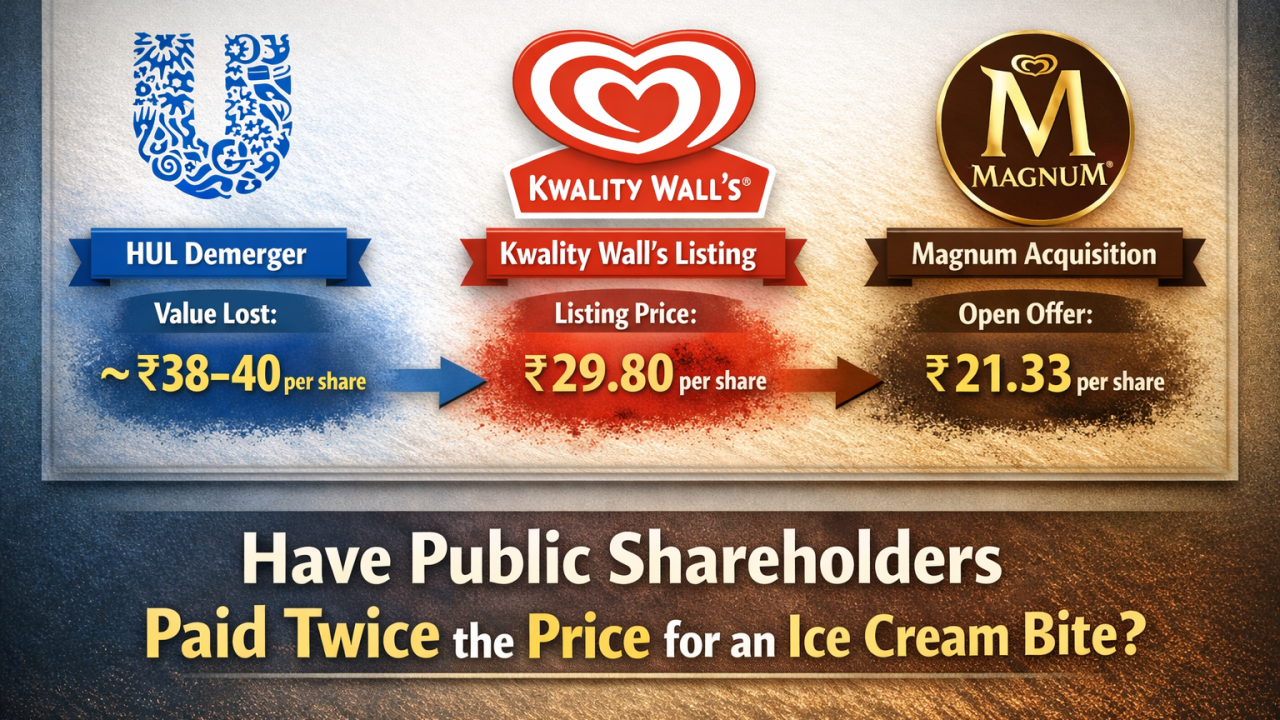
HUL’s share price adjusted downward by roughly ₹38–₹40 per share.
Which means shareholders had already paid economically through reduction in HUL value. That became their mental anchor. Without consciously realising it, many investors started viewing the ice cream business somewhere near that range.
Then listing day arrived and markets gave their own answer
When Kwality Wall’s listed independently in February 2026, the opening price was around ₹29.80.
Already lower than what many had mentally expected. And that was a fair market signal. Because once a business stands alone, the market starts asking harder questions:
- What are sustainable margins?
- How seasonal is earnings visibility?
- Can standalone management improve returns?
The market was cautious, but still assigning meaningful value.
Then came the number that triggered debate — ₹21.33
Soon after listing, The Magnum Ice Cream Company moved ahead with acquisition of controlling stake, which triggered an open offer at ₹21.33 per share.
And suddenly, many shareholders looked back at the journey:
- HUL adjustment near ₹40
- listing near ₹30
- open offer at ₹21.33
That is where the discomfort begins. Not because regulation was violated. But because lived economics and formula pricing started telling different stories.
To be fair, the open offer price did not come arbitrarily
It followed regulatory valuation norms. Independent valuers assessed the business. One report arrived at ₹21.33, another near ₹20.95. Under takeover rules, the higher applicable number became the offer price.
So legally, the process appears robust. And yet, minority shareholders rarely think like valuation reports. They think like owners.
A simple question naturally arises: If value came out of HUL near ₹40, why is strategic control settling near ₹21?
Perhaps global context explains part of it
This is also happening globally. Unilever itself separated its ice cream business globally under Magnum, and even there valuation came below earlier market expectations.
That tells us something important: Ice cream businesses today are not receiving premium multiples automatically. Investors globally are cautious because:
- energy costs are high
- cold-chain is expensive
- margins are less predictable
- seasonal businesses get discounted faster
So India is not completely isolated from that reality.
But the real answer may come from shareholder behaviour, not valuation reports
The open offer sought 26% additional equity. What matters now is not just the offer document. It is whether shareholders actually tender shares at ₹21.33.
Because if the market price remains higher, investors may quietly send their own verdict: We understand the formula, but we do not agree with the economics. And that may become the strongest market commentary of all.
Maybe the larger issue is timing
Had the company traded independently for longer, perhaps valuation would have settled more naturally. Institutions would have participated more deeply. Price discovery would have matured. Instead, strategic acquisition arrived very quickly after listing.
So one cannot help but wonder: Did the market get enough time to decide what Kwality Wall’s was really worth?
This may not be a question of legality. It may simply be a question of whether public shareholders experienced too many valuation realities too quickly.
Sometimes numbers are compliant. Sometimes markets are unconvinced. And occasionally, both can be true at the same time.
Should demerged businesses get more time for genuine market discovery before strategic pricing takes over? Should demerger-linked open offers require an additional fairness premium when control shifts before true market discovery?
Businesses often reach defining moments where the quality of decisions matters more than the size of the transaction itself — whether during acquisitions, divestments, restructuring, partnerships, negotiations, or capital allocation.
At such moments, clarity, timing, and structure become critical. StoreOfValue is a boutique advisory platform focused on helping businesses, promoters, and leadership teams navigate these strategic situations with perspective, discipline, and value-oriented thinking.
Our aim is simple: Empowering Decisions. Fostering Growth.
Because long-term value is often shaped not only by what is done, but by how and when it is done.
From transactions and M&A to restructuring, negotiations, and strategic decision frameworks, thoughtful advisory can often unlock outcomes far beyond the immediate deal. To discuss transactions, restructuring, strategic partnerships, or value creation frameworks, connect with us at Office@storeofvalue.in
#Transactions #MergersAndAcquisitions #Restructuring #StrategicAdvisory #ValueCreation #PromoterMindset #StoreOfValue