

#LEADWITHINSIGHT · EDITION 05
The short answer
Yes, on these facts. NCLT Ahmedabad sanctioned a composite scheme under Sections 230 to 232 of the Companies Act, 2013 in which preference share capital was cancelled and replaced by an unsecured loan, and held that this restructuring forms an integral part of the composite arrangement and may be given effect to on sanction. The sanction is subject to compliance with all applicable accounting, tax and regulatory requirements.
What does the scheme holds
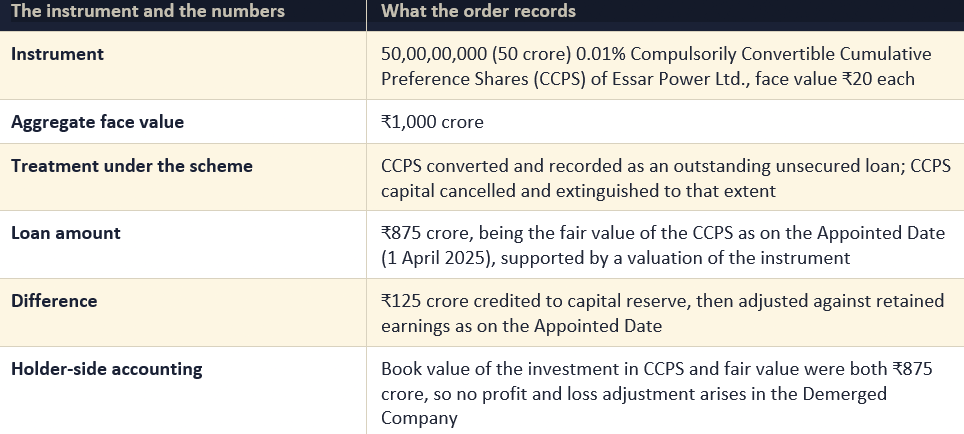
The scheme combined two things. First, a demerger of the Brand Undertaking of Abhinand Ventures Pvt. Ltd. (Demerged Company) into Essar Power Ltd. (Resulting Company), with 61,98,19,330 fully paid-up equity shares of ₹4 each to be issued to the eligible shareholders of the Demerged Company. Second, a restructuring of the Resulting Company's CCPS. The Appointed Date is 1 April 2025. The requisite class meetings were held on 18 and 19 April 2026, and the Chairperson's reports confirmed approval.
The stated rationale for the CCPS restructuring included rationalising the corporate structure, preventing dilution of ownership and voting rights, limiting future share conversion, reducing fixed dividend obligations and simplifying the capital structure for future fund-raising.
The pushback, and how it was answered
Registrar of Companies. The RoC said the scheme is in substance a redemption of preference shares by way of an unsecured loan against each share, and asked why no application was filed in compliance with Section 55(3).
Petitioner companies. They argued that Section 55(3) deals only with a company unable to redeem existing preference shares that proposes to issue further redeemable preference shares in lieu. CCPS are compulsorily convertible and carry no redemption right or entitlement to return of capital, so nothing is redeemed or repaid. The transaction is a substitution with an unsecured loan obligation of equivalent fair value, falling within Sections 230 to 232, with affected-class rights protected through the class meeting and approval mechanism under Section 230.
Tribunal. Having considered the objection and the response, the Tribunal held, having regard to the terms of the scheme, the nature of the restructuring and the approvals obtained, that the restructuring is an integral part of the composite arrangement and may be given effect to. The order records the competing positions but does not set out a detailed Section 55 analysis, so its precedent value on that point should not be overstated.
A related point. The Regional Director also raised Section 66 in connection with an earlier variation of 89,87,97,788 CCPS into Compulsorily Redeemable Preference Shares in FY 2023-24 under Section 48. The Tribunal had clarified that this conversion is not part of the present scheme.
What C-suite and founders can take from this
1. Capital restructuring can travel inside a scheme. If it is integral to the arrangement and the affected class approves it, Sections 230 to 232 can carry more than a merger or demerger.
2. Price it at fair value and document the valuation. The ₹125 crore gap between face value and fair value was routed to capital reserve and set off against retained earnings. The matching carrying value on the holder side meant no P&L hit there.
3. Expect the Section 55 question. Be ready to show why the instrument is not redeemable, why no capital is returned, and why this is substitution and not redemption.
4. Equity into debt changes your profile. An unsecured loan sits ahead of equity and may interact with covenants, ratios and lender consents. The stated benefits here were no further conversion dilution and no fixed dividend burden.
5. Sanction is not tax comfort. The order states it is not a determination of tax liability and leaves the Income Tax Department free to examine the tax consequences. Accounting must follow Section 133 and Ind AS, with the statutory auditors reporting accordingly.
Where to be careful
This is a single bench ruling on specific facts, in a composite scheme where the CCPS restructuring was tied to a demerger and approved by the relevant classes. It is a useful signal for structuring, not a template. The order also states that sanction does not grant any exemption from stamp duty, tax or other statutory levies, and does not absolve any company, director or officer of statutory liability.
Lead with Insight is our ongoing series where we unpack regulatory developments, structuring signals, and transaction trends that matter to promoters, developers, and family offices.
At Store of Value, we believe the best restructuring is the one that survives regulatory scrutiny, not just the one that looks clean on paper.
Source: NCLT Ahmedabad (Division Bench, Court-1), order dated 31 August 2026 in CP(CAA)/22(AHM)/2026 in CA(CAA)/1(AHM)/2026. This note is for general information and is not legal, tax or financial advice.
Original author: StoreOfValue. Shared through StoreOfValue’s LinkedIn page. View the original article on LinkedIn.