LeadWithInsight | Series 01 — Regulatory Intelligence
On February 20, 2026, SEBI issued an informal guidance that flew under the radar — until it was made public on May 22, 2026.
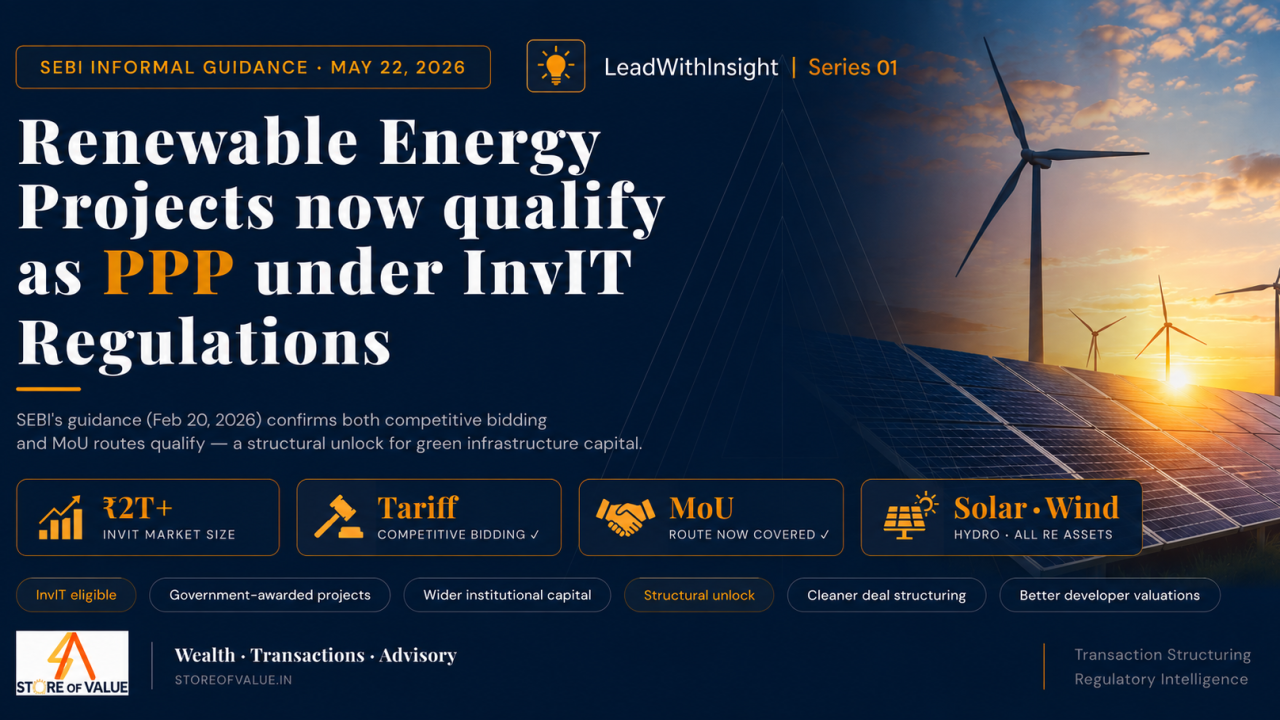
Renewable energy generation projects awarded by public/governmental entities, whether through tariff-based competitive bidding or the MoU route, qualify as Public-Private Partnership (PPP) projects under the SEBI (InvIT) Regulations, 2014.
Regulation 2(1)(zm) defines a PPP project to mean an infrastructure project undertaken on a PPP basis between a public concessioning authority and a private SPV concessionaire selected on the basis of open competitive bidding or on the basis of a Memorandum of Understanding with the relevant authorities.
Why this matters
Infrastructure Investment Trusts (InvITs) were designed to unlock long-term, patient capital for infrastructure by allowing sponsors to monetise operational assets and channel institutional money into projects that generate stable, predictable returns.
Until now, there was meaningful ambiguity around whether renewable energy projects, especially those structured via MoUs rather than formal concession agreements, would pass the PPP eligibility test under the InvIT framework. SEBI has now removed that ambiguity. Both routes qualify.
What this unlocks for renewable energy developers and investors
- Monetisation at scale: Operational solar, wind, and hydro assets awarded by state or central government entities can now be bundled into an InvIT structure, freeing up sponsor capital for the next round of project development.
- MoU-route projects now included: This is particularly significant for projects in states where MoU-based allocation is the dominant procurement model. Those assets are no longer structurally disadvantaged.
- Wider investor access: InvITs trade on stock exchanges, bringing pension funds, insurance companies, and retail investors into green infrastructure financing, deepening the capital pool meaningfully.
- Better valuations for developers: Listed InvIT structures typically command better valuation multiples than unlisted holding companies, improving exit economics for promoters and PE sponsors alike.
- Simplified deal structuring: With regulatory clarity on PPP classification, transaction structuring becomes cleaner: fewer carve-outs, fewer opinion risks, and smoother due diligence.
Although expressly subject to the facts and circumstances of each case, this proactive informal guidance significantly reduces ambiguity around the classification of renewable energy assets in InvIT structures and provides welcome regulatory clarity for market participants.
At Store of Value, we work at exactly this intersection where regulatory clarity translates into transaction opportunity. We have advised promoters, developers, and family offices on structuring renewable energy assets, evaluating InvIT eligibility, and designing exit-ready holding structures. When ambiguities like these resolve, they create a defined window, and those who act with speed and structural clarity win.
If you are holding operational renewable energy assets awarded by a government entity and have been deferring the monetisation question, that deferral just got harder to justify.
Reach out if you would like to discuss what this guidance means for your portfolio or pipeline.
LeadWithInsight is our ongoing series where we unpack regulatory developments, structuring signals, and transaction trends that matter to promoters, developers, and family offices.
#InvIT #RenewableEnergy #SEBI #InfrastructureFinance #GreenFinance #EnergyTransition #TransactionStructuring #StoreOfValue #PPP #WealthAdvisory #IndiaInfrastructure #DealStructuring #Familyoffices